My system for reducing decision fatigue
Does this sound familiar to you?
You plan each day from scratch.
Do I hit snooze or not? Which notification do I open first? Which email do I respond to? What do I cook for breakfast? What do I drink? Do I go to the gym today (based on how groggy I am)? Ah I’m sleepy, I’ll just eat the crappy easier option. What do I wear to work today? Do these colors match? Wait, is it raining today? Do I need to shave?
When do I need to leave? What podcast should I listen to on the way?
What am I eating for lunch today?
What do I work on first?
The worst part is many of these decisions are made based on mood and how you slept.
I wrote a different article about how I finally fixed my sleep.
If you sleep well, then you make good long-term decisions, like eating healthy or working out, or making the most of your time instead of doom-scrolling.
If you sleep badly, then that all goes out the window. You don’t have the discipline or mental energy to overcome the addiction economy.
Your plan for the day doesn’t have resilience, structure, or time-efficiency. It depends far too much on your mood and non-existent discipline.
Just a few weeks ago, I planned each day from scratch.
Most of my brain power was used up figuring out how my time was allocated during the day, which didn’t leave much to let me make progress in other parts of my life.
I didn’t know if I had to cook or if I had to clean, what I was going to wear, whether I had enough water, the temperature in the room, whether my muscles were in atrophy from sitting all day.
It was like I was in a lower state of consciousness, just like the geese and squirrels I always see foraging for food rather than working on scientific discoveries.
However, after some brainstorming, I’ve figured out a solution that has made a significant impact on my life, and I wonder why I hadn’t been doing it a long time ago.
Below, I’ll outline the key shift in my thinking that unlocked many more hours per day and allowed me to make progress on my work with limited time and energy.
Climbing Maslow’s Hierarchy of Needs as fast as possible
Many of the things we get stuck on are on the bottom two rungs of Maslow’s Hierarchy of Needs.
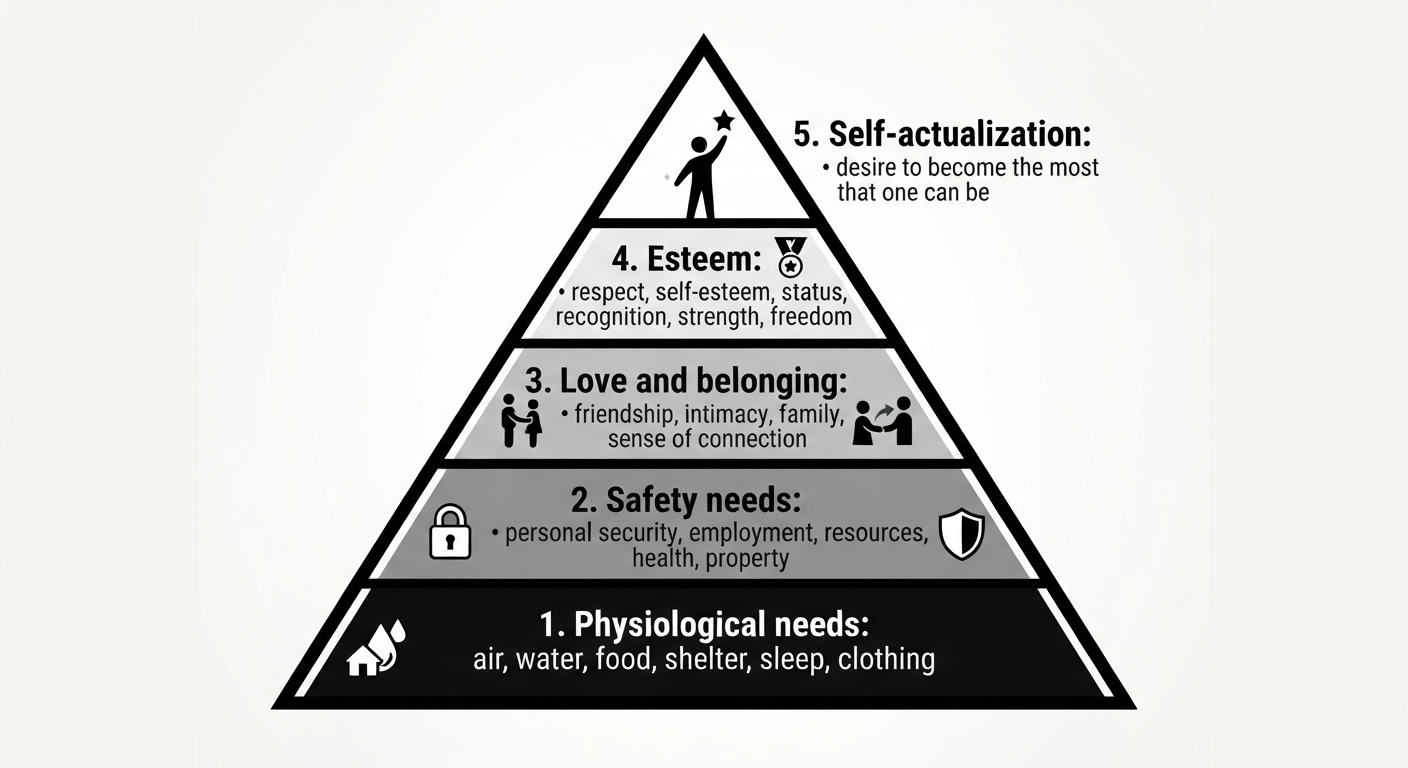
Basic things like air, water, food, shelter, sleep, clothing. Once we’ve figured that out, we figure out the rung above it, and so on.
The faster you can satisfy your requirements, the faster you get to the top rung, self-actualization, which is where you really want to be. That’s where the most important work gets done.
The problem is, if you’re climbing the rung from the bottom every single day, that takes a significant amount of time and energy. By the time you’re at the top, the best of your resources are spent.
No wonder the only thing you want to do after you’re done is go to bed, wake up tomorrow, and repeat the same thing from the beginning.
Luckily, there are a few simple ways you can address the bottom three rungs of the hierarchy: physiological needs, safety needs, and belonging needs.
The key insight is that there’s a FLOOR level of progress you must meet in each of these criteria to proceed. It’s important not to exceed the floor, so you have enough energy left over for the next tiers.
Here’s how I recommend you set your floors to have an actually decent standard of life.
Physiological needs
- Air: clean air at a good temperature.
Get an air purifier and an air conditioner. Open the window when it gets stuffy.
- Water: own multiple water bottles. Place one everywhere you sit.
I have one water bottle on my desk, one next to the bed, one in the kitchen, one in my bag, and more cold water (Brita) in the fridge.
- Food: ingredient prep.
A carb (rice, potatoes, legumes, beans), a protein (your choice), and frozen or meal-prepped veggies (broccoli, cauliflower, carrots).
Overnight oats for breakfast.
Greek yogurt as a snack.
Eat your meal prep for one meal, eat eggs (egg whites, three eggs, black beans, spinach) for the other.
Switch up the meal prep every few days, everything else stays constant. You can change the toppings or the type of beans or the types of veggies or the protein, and so on.
Basically, the least amount of prep to tackle a huge part of your life.
- Shelter: for our purposes, I’ll consider this cleanliness.
This means doing the dishes immediately after you eat. Vacuuming or sweeping once a week.
(I use a spreadsheet system for keeping track of recurring tasks like cleaning.)
Keep your desk absolutely clear. Clear desk, clear mind.
Have a junk drawer that you can just throw stuff into.
Throw things away that you don’t use. Try not to be attached. I’ve thrown away bags and bags of stuff over the last few months, and I don’t miss or even remember what I threw away.
- Sleep
So important to get right, this should be first on the list.
Read my other in-depth article about this.
- Clothing
Wear the same few sets of clothes over and over again. Have pre-defined “outfits” instead of making new ones every day.
This article assumes that the most important thing in your life is self-actualization.
If you care about fashion more than that, that’s a willing tradeoff you make, and there’s nothing wrong with that as long as you’re conscious about it.
Safety needs
- Health
Work out three times a week. Two days lifting (with one day of sprints) an hour each, one day of zone-2 cardio for an hour.
Stretch every day in the morning and night, or do yoga (it works as meditation too).
Eat right (as above).
Get sunlight (once in a while walk to get groceries instead of using Instacart).
For mental health, give yourself a small food treat once a day or eat whatever you want one day a week (as in the Slow-Carb Diet by Tim Ferriss).
Have a meditation, yoga, or mindfulness practice for mental health and progress too.
- Security, resources, property, I won’t address that here.
Love and belonging
A lot of people go into monk mode when they try to make progress in their life, and as a result lose a lot of their friends and relationships, and don’t keep up with family, with whom they have limited time.
The problem with this is that relationships that go bad are not easy to fix later.
Also, a large part of what makes us happy is great relationships, so why lose this for some sort of gain in the future?
There’s a way you can keep your relationships and make new ones too.
It’s just important to set a limit so that you’re not spending too much time on this, once again, a floor.
For me, that means I spend dinner with my girlfriend every day that we can, and a full afternoon on the weekend. Anything more than that is a nice-to-have.
That’s the trade-off I’m making to make extra progress in other parts of my life.
Currently, I don’t have many friends, so that works out for me. I’m also able to spend lunch with any new connections I make.
The result
The rest of the time can be spent on esteem and self-actualization, which I believe are related.
I’ll talk about how to maximize your time here in a different article. There are many ways to do this too.
The key insight to all of this is that you should set a floor for every tier on the hierarchy that lets you advance to the next one as quickly as possible.
Obviously, this means you’re making a trade-off. Not every part of your life can be perfect like an influencer’s.
However, this is the best system I’ve found that allows me a baseline level of life without falling into depression, bad health, and loneliness, while pursuing my true goal of self-actualization.
The first thing you have to do to implement this system into your life is set a “baseline” for each aspect of Maslow’s hierarchy of needs.
That baseline will differ for everyone, depending on different goals and needs.
The practice of writing your baseline down will allow you to make sacrifices in those areas without feeling guilty.
I truly believe this is the most important productivity hack I’ve discovered accidentally in the last month.
I don’t scramble anymore, and my life feels structured in a way that lets me pursue more important tasks than, say, cooking.
As your level of income increases, you can also just start paying someone to do your baseline tasks. You can pay someone to:
- cook for you
- clean for you
- buy you clothes
- train you for optimum health
- drive you around
So that you can actually focus on the things that matter.
This goes back to dollarizing your time.
If you’re paid $100/hour, is it really worth spending an hour every day cooking?
Is it worth losing an hour to brain fog because you didn’t sleep right?
What about producing low-quality work, looking and feeling worse (thereby affecting your confidence) because you didn’t realize you were dehydrated?
You must have a little more self-respect and dollarize your time a little more than what you think you’re worth.
By doing that, you’re one step closer to getting there.
If this resonated
Get my latest writing and thoughts delivered to your inbox.